
There is nothing more frustrating than a sudden frame drop in the middle of a game or system lag when you are in the thick of your workday. A sluggish computer has a way of halting productivity and putting an end to an otherwise good gaming session. The expectation is for applications to load quickly and multitasking to be seamless, so making your PC run at its best is something I have made a priority of.
It is the accumulation of heavy software, temp files, and background services that will slowly drain your CPU and memory. Yet one does not have to resort to costly hardware to overcome such bottlenecks.
In this guide, we present some proven technical approaches to Speed Up My PC without any fuss. See what the TurboCharger App can do to make your Windows setup as efficient as possible.
Why You Need to Speed Up My PC for Gaming and Work
There is no escaping system slowdowns, whether one is a casual gamer or a working professional. Latency becomes all too apparent once the hardware can no longer meet the total demand for resources. You will see response times suffer in the face of high-CPU work and contention from background threads.
Take modern video games, for instance: they are insatiable when it comes to processing power and fast RAM. If a background program makes off with those resources, frame rates nosedive, leaving you with input lag, micro-stuttering, and the occasional crash.
The same holds true for a professional’s workflow. Applications for 3D design, video editing, or compilation need their share of compute cycles. Pairing these applications with a browser full of open tabs puts a strain on system memory. This is why proper optimization of dynamic resource distribution is a must for any kind of multitasking. With memory paging and thread queues in order, the OS can work effectively; an optimized machine will be faster and run cooler.
Then there is a matter of longevity for your desktop. A system that is constantly saturated will build heat inside the case, forcing the CPU to engage in thermal throttling and drop its clock speeds as a safeguard. By keeping a rein on background apps, processor temperatures stay in check. The system will be quiet and dependable even under a sustained load, allowing for peak performance without the need to invest in costly cooling solutions.
Proven Methods to Speed Up My PC and Boost System Power
There are several ways to put an end to slow computing and see faster performance right away. Some of them are as follows:
- Manage Startup Programs and Background Services
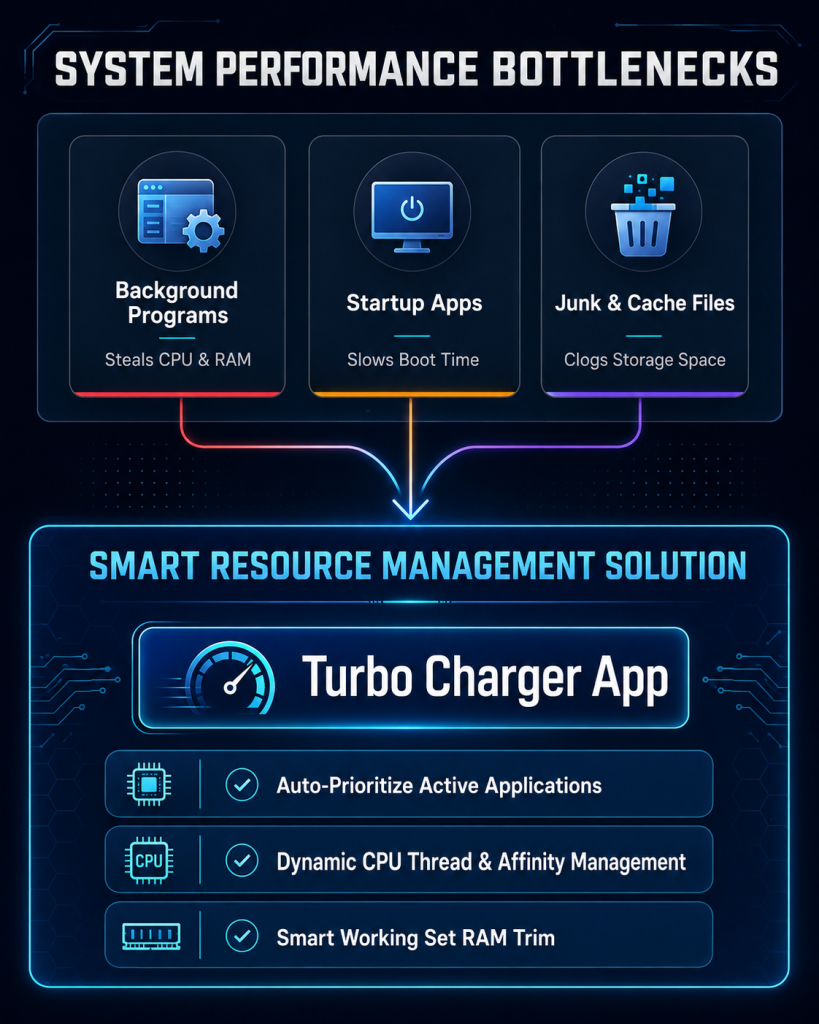
It is common for applications to put in automatic registry startup entries as part of the installation process. The trouble is that such programs are using memory and CPU from the moment the system boots, which in turn slows down the loading of your desktop’s background drivers and services.
To remedy the situation, one can open the Task Manager with a quick Ctrl + Shift + Esc and have a look at the Startup Apps tab. Any non-essential entries can be disabled there to free up some system memory right away. A similar pass-through active Windows Services in “services.msc” will allow for the removal of any superfluous third-party updates or telemetry. Such a focused approach to housekeeping will do much to reduce idle background load and shorten boot times.
- Clean Temporary Files and Optimize Drive TRIM
In the course of normal software use, Windows will put out its share of cache files, logs, and temporary dumps. Before long, such superfluous material can clog your primary storage. This is more than an inconvenience; a lack of free space on the drive will hamper how Windows goes about its virtual memory and pagefile swapping duties.
To make some headway on this issue, hit Windows + R to bring up the Run dialog. Enter %temp% to see any hidden application data left behind. Delete the old files there, and you will quickly free up space on your solid-state drive. It is also worth making sure Windows is running its drive optimization and TRIM commands on a regular basis. The latter is important for an SSD, as it tells the controller which blocks are open for writing, keeping speeds where they should be.
- Adjust Windows Power Profiles and Visual Effects
By default, Windows is set to a balanced power management profile in the interest of energy conservation. The problem with that mode is it will park CPU cores and put off frequency boosts when faced with bursty workloads. To remedy this, go to Power Options in the Control Panel and change the active plan to either High Performance or Ultimate Performance. That way the system will not park any cores, and clock speeds are maintained at their maximum base. You should also take care of the visual performance settings under System Properties. Turning off the more elaborate window animations is a simple way to immediately reduce GPU compositing overhead a simple way to reduce GPU compositing overhead immediately to cut down on GPU compositing overhead right away.
How Turbo Charger App Restores Peak PC Speed
To optimize a system by hand is no small task; it demands an intimate understanding of the system, as well as ongoing maintenance and vigilance. For those new to it, navigating the intricacies of service dependencies, process priorities, and Windows registry adjustments can be a trial. If you wonder how do i speed up my PC without risky manual steps, automated software offers the ultimate solution.
The TurboCharger App takes a different approach, making resource management effortless with dynamic automation. Instead of shutting down processes one by one, the software handles allocation for you. It will pick up what is in your foreground window and direct the necessary computing power to whatever game or application has your attention.
Dynamic CPU Priority and Core Affinity Control
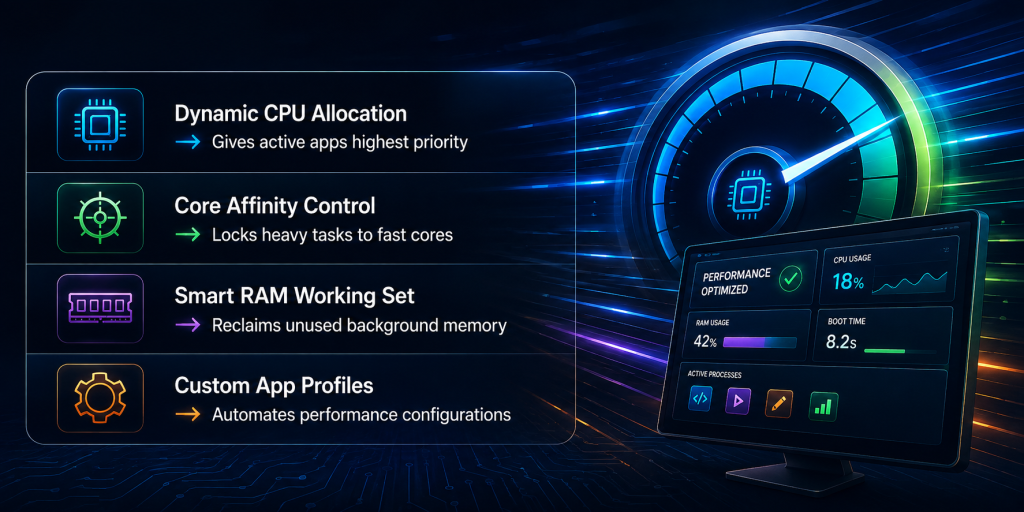
Resource-heavy software tends to put background apps in direct competition for the same CPU time. The TurboCharger app overcomes that kind of scheduling bottleneck with its dynamic thread priority system. By keeping an eye on what has focused on the active window, the application will on its own raise a process to a high or above normal status.
Take a graphically intensive game as an example: once it is up and running, the app diverts CPU cycles from any secondary processes in the background. On top of handling core affinity so that heavy threads are assigned to the primary performance cores instead of the more power-efficient ones, this approach means the title at hand gets all the processing throughput needed for smooth frame rates. Video editors, 3D renderers, and developers can achieve the same improvement during exports. And should one wish to set up a dedicated execution profile for a given program, an intuitive-to-use visual interface makes for simple customization.
Automated RAM Working Set Trim and Memory Management
There is a tendency for software memory leaks to induce random micro-stuttering over the course of an extended computing session. Even in a minimized state, background applications will at times cling to their physical RAM allocations. To counter this, the TurboCharger keeps a real-time watch on system memory. By means of controlled working set trims, it puts back any superfluous background memory into the available pool. The computer is thus able to stay responsive at all times, and there is no need to reboot the system.
Practical Guide on How to Speed Up PC Performance Daily
For the best performance, you need to develop good computing habits every day. It is the small adjustments to your routine that will lead to significant improvements in hardware responsiveness over time.
Here are some practical ways to put more speed into PC operations:
- Make sure drivers are current by going to the source and installing the latest versions for your GPU, chipset, and network from the manufacturer.
- Do away with software you no longer need; there is no point in having an old application sitting in the tray and quietly running background update services.
- Be mindful of browser tabs. Either shut them when not in use or put in an extension to suspend them to avoid draining the RAM.
- Let the Turbo Charger App take care of core affinity and app priorities in a dynamic fashion.
- And make it a habit to give the desktop a weekly reboot. This will clear out any pending update state locks and active system memory pools.
Such regular maintenance is what keeps software from slowing you down at an inopportune moment. The result is a fast and stable system that does not require much in the way of technical head scratching.
Real-World Scenarios: Gaming vs. Work Optimization
Different computing workloads require distinct system tuning approaches. The table below illustrates how automated resource management solves distinct operational bottlenecks:
| Task Type | Primary Hardware Bottleneck | Common System Symptom | Turbo Charger App Technical Solution |
| PC Gaming | CPU thread queues & GPU memory | Frame drops, input lag, micro-stutters | Boosts active process priority and locks execution to performance CPU cores |
| Video Editing | RAM capacity & Multi-core CPU | Slow timeline rendering, preview lag | Allocates maximum CPU thread access and trims idle background working sets |
| Software Coding | RAM capacity & CPU build threads | Delayed IDE response, slow compilation | Maintains highest scheduling priority for active compilers and local build servers |
| General Work | System pagefile & Background apps | Unresponsive browser windows, system delay | Cleans inactive application memory and limits idle tray process thread usage |
By understanding these performance distinctions, you learn how to speed up PC performance precisely for your exact daily setup.
Conclusion
There is nothing more of a hindrance to your day’s work or a competitive game than a computer that is not keeping up. The good news is that you do not need to spend a lot on expensive hardware to eliminate such system lag. A bit of housekeeping on startup programs, emptying the temp cache, and tweaking power settings will get you back on track quickly. Then again, that sort of manual upkeep is only as effective as your technical know-how and vigilance.
For a more straightforward approach, an automated solution like the TurboCharger App makes maintenance a non-issue. It puts CPU and RAM where needed most, so your main applications perform at their best. The result is effortless multitasking and games that run without a hitch. Why not put your desktop back in its place? Go to the Turbo Charger App website and put the free trial to the test for some truly unencumbered speed.